

How to Choose the Right Giveaway Prize
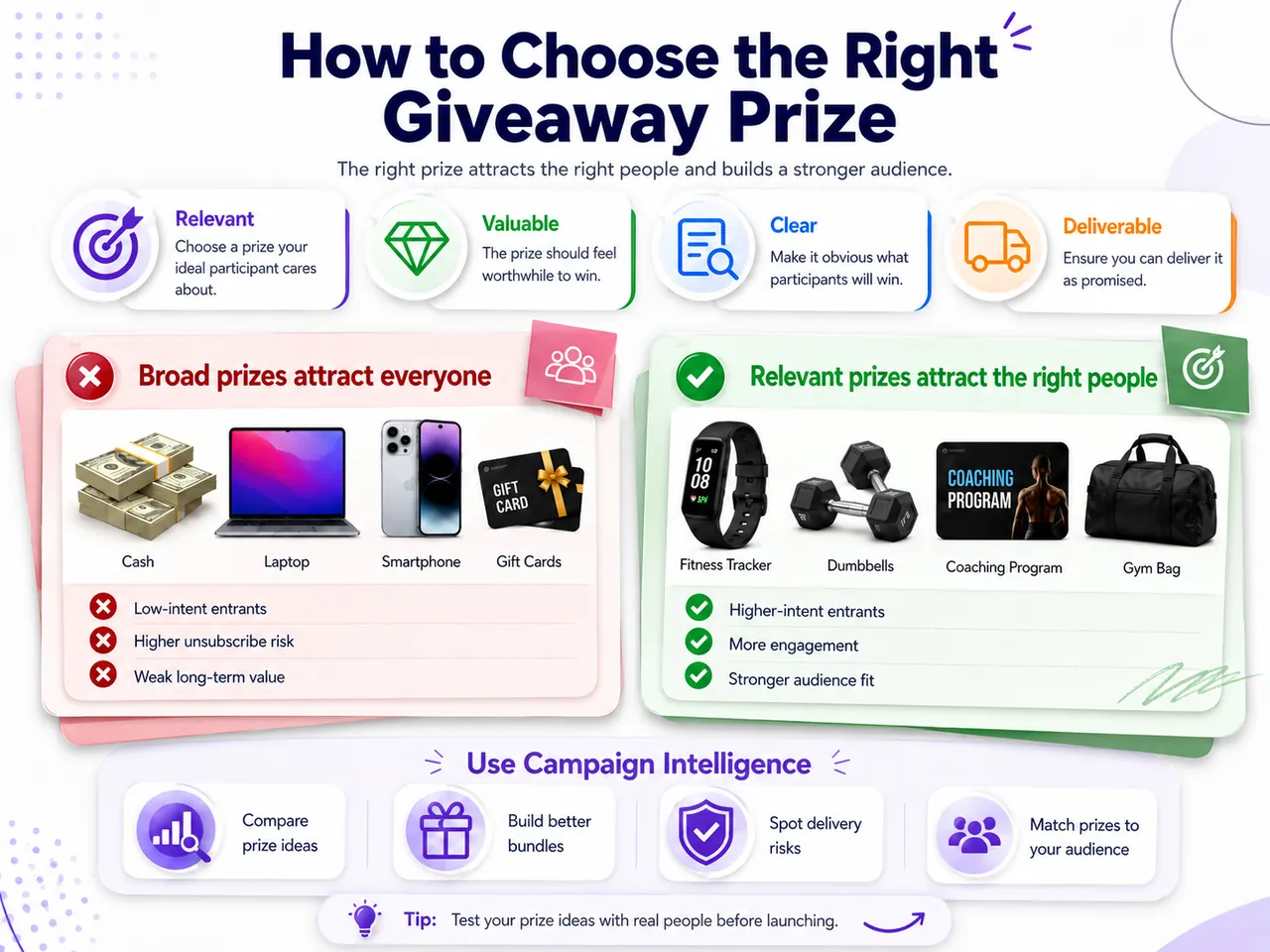
How to Choose the Right Giveaway Prize
The prize is one of the most important decisions in any giveaway.
It determines who notices your campaign, who enters and whether those participants are likely to care about your brand after the giveaway ends.
The wrong prize can generate thousands of entries while creating almost no long-term value.
The right prize may attract fewer people, but those people are more likely to become followers, subscribers, customers or repeat participants.
The goal is not to choose the prize that attracts the most people.
It is to choose the prize that attracts the right people.
Start with the audience, not the prize
Many giveaway organisers begin by asking:
What valuable prize can we afford?
A better question is:
What would our ideal participant genuinely want?
Imagine a local fitness business giving away a new smartphone.
The campaign may attract a large number of entries, but many participants will have no interest in fitness, personal training or the business itself.
They simply want the phone.
The same business could instead offer:
- A three-month training package.
- A fitness assessment.
- A personalised coaching program.
- A gym membership.
- A fitness equipment bundle.
The second campaign may receive fewer entries, but those entrants are much more likely to become real customers.
This is the difference between attracting attention and attracting relevant attention.
A giveaway is not successful simply because the entry counter is high.
It is successful when it reaches people who are likely to care about what you do next.
Match the prize to your campaign goal
Before choosing the prize, decide what the giveaway is supposed to achieve.
Common goals include:
- Growing an email audience.
- Increasing brand awareness.
- Attracting potential customers.
- Launching a new product.
- Rewarding an existing community.
- Promoting a collaboration.
- Growing followers.
- Encouraging repeat participation.
Your prize should support that goal.
For example:
- A software business could offer a one-year subscription.
- An ecommerce brand could give away a new product bundle.
- A creator could offer merchandise and a private livestream.
- A consultant could offer a strategy session.
- A local restaurant could offer a dining experience.
- A musician could offer signed merchandise and event tickets.
The strongest prizes lead naturally into what the campaign owner already creates, sells or provides.
Ask yourself:
What should the winner still want from us after receiving the prize?
If the prize has no connection to your content, product, service or community, the audience may disappear as soon as the giveaway ends.
Use GiveLab Campaign Intelligence before committing
Choosing a prize does not need to rely entirely on guesswork.
GiveLab Campaign Intelligence can help you explore and compare prize ideas based on your:
- Campaign objective.
- Target audience.
- Industry or creator category.
- Budget.
- Audience location.
- Entry requirements.
- Products or services.
- Preferred campaign size.
- Desired participant quality.
Instead of simply suggesting the most expensive or popular prize, Campaign Intelligence can help you identify options that fit the audience you actually want to reach.
For example, it may suggest that:
- A fitness coach offer a personalised training program instead of cash.
- A gaming creator combine relevant equipment with a private gaming session.
- A software company offer premium access and onboarding support.
- A local business create a prize bundle with nearby complementary businesses.
- An ecommerce brand use a new product bundle instead of a general gift card.
Campaign Intelligence can also help you:
- Compare multiple prize ideas.
- Build a themed prize bundle.
- Match prize value to entry effort.
- Suggest runner-up prizes.
- Identify possible shipping complications.
- Improve the prize description.
- Connect the prize to the campaign objective.
- Avoid prizes that are too broad for the intended audience.
Campaign Intelligence should support your judgement, not replace it.
You still need to confirm that the prize is available, appropriate and practical to deliver.
No tool understands your audience as well as you should.
The four qualities of a strong giveaway prize
A strong giveaway prize should be relevant, valuable, clear and deliverable.
Relevant
The prize should appeal specifically to the audience you want to attract.
Ask:
- Would my ideal customer want this?
- Would my existing followers care about it?
- Does it connect naturally to my content or business?
- Would the winner still care about what I do afterward?
If almost anyone would want the prize, the campaign will probably attract a broad and less targeted audience.
That may be acceptable for a mass-awareness campaign, but it is usually weak for a niche business or creator.
Valuable
The prize must feel worthwhile compared with the effort required to enter.
Value does not always mean high cost.
A private consultation, limited-edition item or exclusive experience may feel more valuable than an expensive generic product.
The participant’s perceived value matters more than your cost.
A prize costing you $100 may feel more desirable than a $500 item if it is rare, personal or unavailable elsewhere.
Clear
Participants should immediately understand what they can win.
Avoid vague descriptions such as:
- Ultimate prize package.
- Mystery reward.
- Incredible experience.
- Exclusive bundle.
Explain exactly what is included.
Weak description:
Win the ultimate creator package.
Stronger description:
Win a creator equipment package including a microphone, ring light, tripod and six months of editing software.
Clarity builds trust.
It also helps participants decide whether the prize is relevant enough to justify entering.
Deliverable
You must be able to provide the prize exactly as described.
Before launching, confirm:
- Product availability.
- Shipping costs.
- Eligible locations.
- Delivery timeframes.
- Taxes and customs.
- Booking availability.
- Expiry dates.
- Age restrictions.
- Collection requirements.
- Any additional costs for the winner.
Do not publish the campaign first and solve delivery problems later.
If you cannot confidently deliver the prize, do not advertise it.
Relevant prizes usually outperform generic prizes
Generic prizes have broad appeal.
Examples include:
- Cash.
- Smartphones.
- Laptops.
- Gaming consoles.
- General gift cards.
- Tablets.
These prizes often produce large entry numbers because almost everyone can use them.
That does not automatically make them bad prizes.
Generic prizes may work when:
- The brand serves a broad consumer market.
- The campaign goal is general awareness.
- The existing audience is already highly targeted.
- The prize is supplied by a relevant sponsor.
- The promotion is limited to an existing community.
The mistake is using a mass-market prize while expecting highly qualified leads.
A local accountant giving away a gaming console should not be surprised when the entrants have no interest in accounting.
A niche business should usually choose a niche prize.
Use your own product or service where possible
One of the strongest prize options is something you already sell.
This attracts people who are interested in the actual business rather than an unrelated reward.
Possible prizes include:
- An annual subscription.
- A premium membership.
- A product bundle.
- A service package.
- A consultation.
- A course.
- Event tickets.
- A personalised session.
- Early access.
- A free upgrade.
Using your own product can also reduce the real cost of the campaign.
A product may retail for $500 but cost the business far less to provide.
However, the product still needs to feel desirable.
Do not give away something insignificant simply because it is convenient.
A small discount, weak free trial or low-value item may not create enough motivation to enter.
The fact that something is free does not automatically make it an attractive prize.
Giveaway prize ideas by audience
Creators and influencers
Creators can offer:
- Signed merchandise.
- Equipment used in their content.
- A private video call.
- Exclusive livestream access.
- A personalised message.
- Membership access.
- Event tickets.
- A content collaboration.
- A behind-the-scenes experience.
The prize should feel connected to the creator.
A creator-branded experience is often more memorable than a generic product that could come from anyone.
Ecommerce brands
Ecommerce prize ideas include:
- A bestselling product bundle.
- A new product before public release.
- A seasonal collection.
- Store credit.
- A limited-edition product.
- A year’s supply.
- A build-your-own bundle.
Bundles can help introduce participants to several products rather than promoting only one item.
They also tend to create stronger campaign images and a higher perceived value.
SaaS businesses
Software companies can offer:
- A one-year subscription.
- A premium plan.
- An onboarding package.
- A strategy session.
- A template bundle.
- Early feature access.
- A subscription combined with expert support.
Be cautious with lifetime subscriptions.
They may create long-term service costs, attract users who never intended to pay and reduce future revenue.
A one-year premium plan is often a safer and more valuable offer.
Local businesses
Local prize ideas include:
- A service package.
- A dining experience.
- A family activity.
- A photography session.
- A beauty treatment.
- A seasonal service.
- A local product bundle.
- A collaboration with nearby businesses.
Local prizes naturally filter out participants who are outside your service area.
Make location restrictions clear before people enter.
Coaches and consultants
Possible prizes include:
- A private consultation.
- A strategy session.
- A business or account audit.
- A personalised plan.
- Access to a course.
- A short coaching package.
- A group program membership.
Do not give away so much time that the campaign becomes a burden.
The prize should feel valuable without becoming commercially destructive.
Musicians and artists
Suitable prizes include:
- Signed merchandise.
- Limited-edition artwork.
- Event tickets.
- Private listening access.
- A personalised creation.
- A commission.
- A collector bundle.
- A private performance.
Scarcity and personal connection can be more appealing than retail value.
A prize that cannot easily be purchased elsewhere can create stronger interest than a generic product.
Gaming creators and streamers
Gaming prizes can include:
- Gaming equipment.
- Platform gift cards.
- Merchandise.
- Private gaming sessions.
- Tournament entry.
- Membership access.
- Game-specific products.
- Sponsor bundles.
The prize should match the games, platform and community involved.
A prize that appeals to all gamers may still be too broad if your audience revolves around one particular game or genre.
Should you offer cash?
Cash attracts attention because almost everyone wants it.
That is also its main weakness.
A cash giveaway may attract people who have no interest in the campaign owner.
Cash can work when:
- The brand has broad appeal.
- The campaign targets an existing audience.
- The objective is mass awareness.
- The cash is connected to a challenge or competition.
- The distribution is already highly targeted.
Cash is usually less effective when the goal is to attract potential customers for a niche product or service.
A relevant prize may create fewer entries but produce a more useful audience.
Do not confuse popularity with strategic value.
Are gift cards a good giveaway prize?
Gift cards provide flexibility without always being as broad as cash.
Their quality depends on the type of card.
General gift cards
These can be used across many stores or categories.
They have broad appeal but often attract lower-intent participants.
Category-specific gift cards
Examples include:
- Gaming store credit.
- Bookstore vouchers.
- Travel credit.
- Beauty retailer vouchers.
- Home improvement vouchers.
These attract a more specific audience.
Your own store credit
Store credit can be highly effective because it gives the winner choice while keeping the reward connected to your business.
Make sure the amount is meaningful.
A $20 credit may not motivate someone to participate if most of your products cost several hundred dollars.
The prize should feel like a genuine reward, not a disguised discount.
One large prize or multiple smaller prizes?
Both approaches can work.
One large prize
Benefits include:
- A stronger headline.
- Simpler promotion.
- Greater excitement.
- Easier administration.
The weakness is that participants may feel their chance of winning is extremely small.
Multiple smaller prizes
Benefits include:
- More winners.
- Better perceived odds.
- More winner stories.
- Greater community participation.
The weakness is that each individual prize may feel less valuable.
A strong compromise is:
- One main prize.
- Several runner-up prizes.
- A small number of bonus prizes.
For example:
- One complete creator setup.
- Three software subscriptions.
- Five merchandise packs.
GiveLab Campaign Intelligence can help compare these structures based on your available budget and campaign objective.
How valuable should the prize be?
There is no single correct amount.
Prize value should reflect:
- The effort required to enter.
- The size of the audience.
- The campaign duration.
- The campaign goal.
- The value of your offer.
- The number of expected entrants.
- The complexity of the submission.
- The uniqueness of the prize.
A simple email entry requires little effort.
A photo, video or design competition requires much more.
The prize must feel proportionate.
Do not ask participants to create valuable marketing content in exchange for a tiny chance of winning a low-value reward.
That is not a clever campaign.
It is an exploitative one.
Perceived value matters more than cost
Some prizes cost little to provide but feel highly valuable.
Examples include:
- Private access.
- Early product access.
- A signed item.
- A personalised review.
- A limited edition.
- A one-to-one session.
- Recognition.
- A behind-the-scenes experience.
- Exclusive community membership.
A private call with a respected creator may cost almost nothing except time but feel more valuable than an expensive generic product.
Look for things your audience cannot easily buy elsewhere.
That is where many of the strongest prizes come from.
Creating an effective prize bundle
Bundles can increase perceived value and make a campaign more visually appealing.
A strong bundle should have a clear theme.
Examples include:
- Creator starter kit.
- Home office package.
- Gaming setup.
- Fitness transformation package.
- New parent bundle.
- Travel essentials.
- Small business launch kit.
- Self-care package.
Avoid combining random products simply to inflate the advertised value.
A bundle containing headphones, cooking equipment, skincare products and car accessories may have a high total value, but it does not attract a clear audience.
Every item should appeal to approximately the same person.
GiveLab Campaign Intelligence can help group related products into a coherent bundle and identify items that do not fit the intended audience.
Working with sponsors
A sponsor may provide the prize in exchange for promotion.
This can lower campaign costs and increase reach.
But an irrelevant sponsor can weaken the entire campaign.
Before accepting a sponsored prize, confirm:
- The sponsor fits the audience.
- The prize is available.
- Who pays for shipping.
- Who communicates with the winner.
- Which locations are eligible.
- What promotion the sponsor expects.
- How the sponsor will be displayed.
- What happens if the prize becomes unavailable.
- Whether participant information will be shared.
Do not assume that providing a prize gives the sponsor automatic access to entrant information.
Participant data should only be shared where it has been clearly disclosed and properly permitted.
A free prize is not valuable if it attracts the wrong audience or damages trust.
Think about shipping before publishing
Physical prizes create practical problems that digital prizes do not.
Check:
- Weight and dimensions.
- Delivery costs.
- Remote-area charges.
- Customs restrictions.
- Tracking.
- Insurance.
- Product availability.
- Warranty.
- Replacement cost.
- International shipping.
Do not open a campaign worldwide without understanding what worldwide delivery actually involves.
A large prize may cost more to ship than to purchase.
You can reduce the risk by:
- Limiting eligible countries.
- Offering a digital alternative.
- Using local suppliers.
- Providing store credit.
- Having the sponsor ship directly.
- Clearly stating collection requirements.
GiveLab Campaign Intelligence may help identify obvious delivery risks, but the campaign owner must verify the final arrangements.
Do not inflate the prize value
The advertised prize value should be honest.
Avoid:
- Using unrealistic recommended retail prices.
- Adding unrelated items together to inflate the total.
- Claiming that a discount is equivalent to cash.
- Including unavailable products.
- Hiding required winner expenses.
- Exaggerating the value of a service.
- Advertising an “up to” amount that does not reflect the real prize.
Participants should understand exactly what the prize includes and what it is genuinely worth.
An inflated headline may increase clicks, but it damages trust.
A campaign built on exaggeration is unlikely to create a valuable long-term audience.
Test the prize before launching
Before committing, ask members of the target audience:
- Would you enter to win this?
- What part of the prize appeals to you?
- Is anything unclear?
- Does it match the effort required?
- Would you still care about the business afterward?
- Which of two prize options would you prefer?
Do not rely only on your team or friends.
They are likely to confirm your idea instead of challenging it.
Ask customers, followers or people who resemble the intended participant.
You can also run a poll before launching the full giveaway.
GiveLab Campaign Intelligence can help you generate the options, but real audience feedback is still one of the strongest ways to validate the final choice.
Common giveaway prize mistakes
Choosing a prize everyone wants
Broad appeal produces broad participation.
That may increase entries while reducing relevance.
Focusing only on price
A more expensive prize is not automatically a better one.
Relevance and exclusivity often matter more.
Giving away something unrelated
An unrelated prize attracts people who disappear as soon as the winner is announced.
Offering too little for the effort
High-effort contests require meaningful rewards.
Ignoring delivery costs
Shipping, taxes and scheduling can turn a simple prize into an expensive problem.
Making the prize unclear
Participants should immediately understand what they can win.
Inflating the value
Exaggerated prize values damage trust.
Accepting the wrong sponsor
A free prize is not useful when it attracts the wrong audience.
Treating AI recommendations as certainty
Campaign Intelligence can help you make a better decision, but it cannot guarantee campaign performance.
Use it to improve your thinking, not avoid it.
Giveaway prize checklist
Before selecting your prize, confirm that:
- It appeals to the intended audience.
- It supports the campaign goal.
- It connects to your product, content or community.
- It is valuable enough to justify entering.
- It is easy to explain.
- You can deliver it as promised.
- The advertised value is honest.
- Shipping and taxes have been considered.
- Location restrictions are clear.
- The entry effort is proportionate.
- Sponsor responsibilities are documented.
- The prize will still be available when the campaign ends.
- The official rules describe it accurately.
- The winner will not face unexpected costs.
- The prize gives participants a reason to care about what you do next.
Frequently asked questions
What is the best prize for a giveaway?
The best prize is one that strongly appeals to the audience you want to attract.
It should connect naturally to your business, content, service or community.
Can GiveLab help me choose a prize?
GiveLab Campaign Intelligence can help you generate, compare and refine prize ideas based on your audience, budget and campaign goal.
It can support the decision, but you remain responsible for confirming that the prize is available and practical to deliver.
Do expensive prizes attract more entries?
They often do, but they may also attract more irrelevant participants.
More entries do not automatically make the campaign more successful.
Is cash a good giveaway prize?
Cash has broad appeal and can work for mass-market campaigns.
It is usually weaker for niche businesses seeking qualified potential customers.
Should I give away my own product?
Usually, provided the product is genuinely desirable.
Your own product attracts people who are more likely to care about what you offer.
Are gift cards good prizes?
Category-specific gift cards or your own store credit can work well.
General gift cards tend to attract a broader audience.
Should I offer one prize or several?
One large prize creates a stronger headline.
Several smaller prizes create more winners and may improve perceived odds.
A main prize with runner-up prizes is often a good balance.
Should the winner pay shipping?
Unexpected winner costs should be avoided.
Any required shipping, collection or travel costs should be disclosed clearly before entry.
Choose a prize that builds the right audience
A giveaway prize is not just a reward.
It is a targeting tool.
It determines who notices the campaign, who enters and whether those people are likely to care about what happens next.
Do not judge a prize only by how many entries it could generate.
Judge it by the quality of the audience it attracts.
A smaller campaign filled with relevant participants can be far more valuable than a large campaign filled with people who only wanted a generic prize.
GiveLab Campaign Intelligence can help you explore prize ideas, compare different options and build a reward that fits your audience, budget and campaign objective.
Use the technology to sharpen the decision, then apply your own understanding of your audience.
Choose something your ideal participant genuinely wants, explain it clearly and make sure you can deliver exactly what you promise.