

How to Run an Online Giveaway: A Complete Step-by-Step Guide
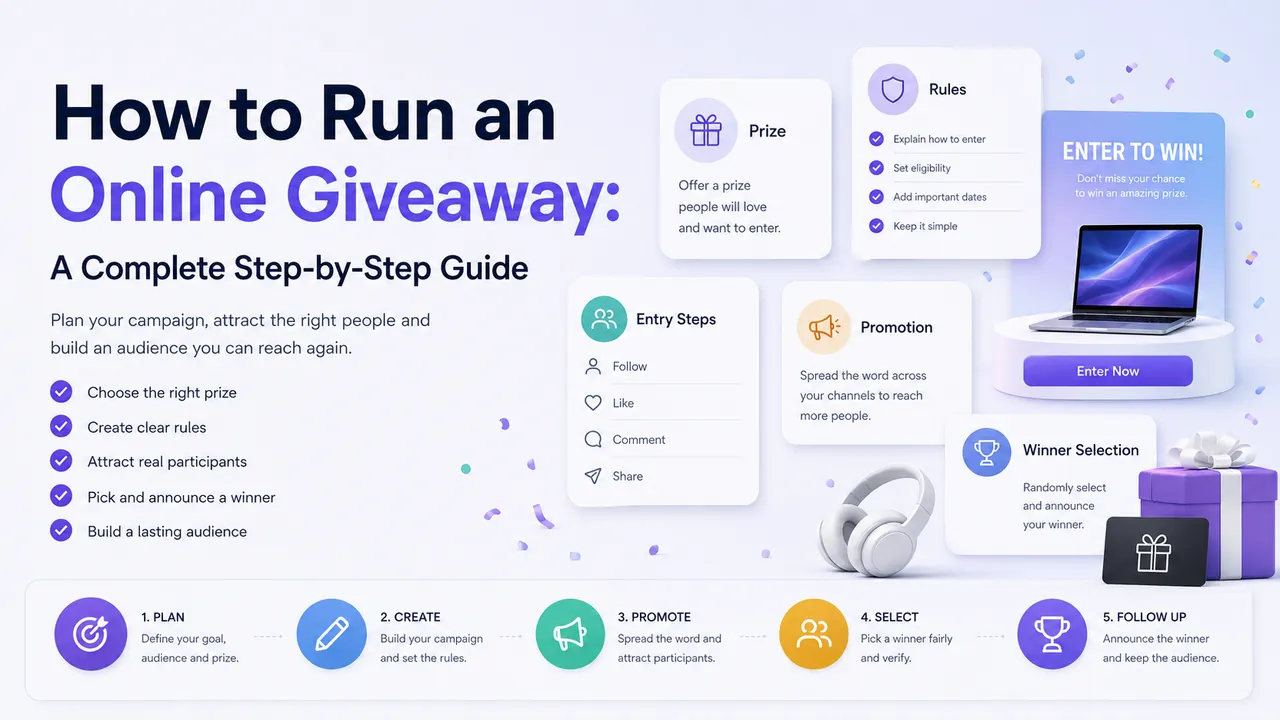
Online giveaways can attract attention quickly, but attention alone is not the same as growth.
A poorly planned giveaway may generate thousands of entries from people who have no genuine interest in your content, business or next campaign. Once the winner is announced, those entrants disappear and your numbers return to where they started.
A successful giveaway should do more than produce a temporary spike.
It should help you:
- Reach the right people.
- Grow an audience you can contact again.
- Introduce people to your brand or content.
- Create genuine participation.
- Build trust by running the promotion fairly.
- Give participants a reason to return.
This guide explains how to plan, create, promote and complete an online giveaway from beginning to end.
What is an online giveaway?
An online giveaway is a promotional campaign in which people complete one or more entry requirements for the chance to receive a prize.
The winner may be selected randomly, judged according to skill or chosen through a public voting process.
The terminology varies between countries and jurisdictions, but these are the most common formats:
Random-draw giveaway or sweepstakes
The winner is chosen randomly from all valid entries.
Skill-based contest
Participants submit something that is judged according to published criteria, such as a photograph, design, video or written answer.
Voting contest
Participants submit entries and the community votes for a winner or finalist.
Instant-win promotion
Participants immediately discover whether their entry has won a prize.
Before creating your campaign, decide which structure you are using. Do not describe the promotion as a random giveaway and then choose the winner based on who submitted the best answer. The selection process must match the rules participants agreed to.
Step 1: Decide what the giveaway should accomplish
Your first decision should not be the prize.
It should be the outcome.
Ask yourself what you want to have after the giveaway ends that you do not have today.
Possible goals include:
- Growing your email audience.
- Attracting followers to your GiveLab profile.
- Launching a product, channel or project.
- Increasing awareness of a new brand.
- Finding potential customers.
- Rewarding an existing community.
- Collecting useful audience information.
- Promoting a collaboration.
- Bringing previous participants back.
Choose one primary objective.
Trying to grow every social account, collect email addresses, increase website traffic, generate sales, promote five sponsors and launch three products through one giveaway usually produces a confusing campaign.
A clear goal makes every other decision easier.
For example, a creator who wants to build an audience they can reach again might make email subscription the main entry action. An ecommerce brand launching a product might direct participants to its product page before offering an optional subscription.
The giveaway should support the objective—not distract from it.
Step 2: Choose a prize that attracts the right people
The best prize is not necessarily the most expensive prize.
It is the prize most closely connected to the people you want to attract.
A generic high-value prize such as cash, a smartphone or a popular games console may generate large entry numbers. It may also attract thousands of professional giveaway entrants who have no interest in your brand.
That creates impressive-looking numbers with little long-term value.
A more targeted prize acts as a filter.
Examples include:
- A software company giving away an annual subscription.
- A photographer giving away a portrait session.
- A gaming creator giving away equipment used in their videos.
- A fitness business giving away a training package.
- An author giving away a signed collection and private discussion.
- An ecommerce brand giving away its own product bundle.
- A musician giving away merchandise and access to a private online event.
Before choosing the prize, ask:
- Would someone who wants this prize also care about what we publish or sell?
- Can we clearly explain what the winner receives?
- Can we realistically deliver it?
- Are there age, location or delivery restrictions?
- Is the prize valuable enough to justify participating?
A $500 prize that attracts 10,000 irrelevant entrants may be less valuable than a $100 prize that attracts 500 potential customers or genuine fans.
Do not optimize for the largest possible number of entries. Optimize for relevant participation.
Step 3: Define exactly who can enter
Your eligibility requirements should be settled before the campaign is published.
Consider:
- Minimum age.
- Eligible countries, states or regions.
- Opening and closing times.
- Whether employees, contractors or family members can enter.
- Whether previous winners can enter.
- Whether multiple entries are allowed.
- Whether the prize can be delivered to every eligible location.
- Whether the campaign involves restricted products or services.
Avoid opening a physical-product giveaway worldwide unless you have confirmed that you can legally and practically ship the prize everywhere.
International campaigns can create complications involving shipping, taxes, customs, sanctions, age restrictions and local promotion laws.
A narrower campaign is often easier to administer and more relevant to the intended audience.
Step 4: Write clear official rules
Every serious giveaway should have official rules.
The rules should explain:
- Who is running the giveaway.
- Who is eligible to enter.
- When the giveaway opens and closes.
- How someone enters.
- Whether entry is free.
- The number and approximate value of the prizes.
- Any prize restrictions.
- How the winner will be selected.
- When the draw or judging will occur.
- How the winner will be contacted.
- How long the winner has to respond.
- What happens if the winner cannot be contacted.
- How personal information will be handled.
- The reasons an entry may be disqualified.
- Whether any social platform is associated with the promotion.
- Where the results or winner announcement will appear.
Do not copy rules from another giveaway and change the business name. The copied rules may apply to a different campaign structure, jurisdiction, prize or platform.
Promotion laws vary significantly. In Australia, competitions and trade promotions are regulated at state and territory level, and permits may be required depending on the promotion and prize value. In the United States, a sweepstakes generally cannot require a purchase, while individual states may impose additional disclosure, registration or bonding requirements.
Your rules must also match the policies of any external platform used to promote or administer the campaign. YouTube, for example, requires official rules, a privacy notice, free entry and a clear statement that YouTube is not sponsoring the contest.
GiveLab can help you administer a campaign, but the campaign owner remains responsible for ensuring that the promotion, prize and official rules comply with the laws that apply to them.
This guide provides general information and is not legal advice.
Step 5: Choose useful entry actions
Every entry action creates friction.
The more actions you require, the fewer people will complete the campaign. More importantly, complicated requirements do not automatically create better entrants.
Avoid turning your giveaway into a list of chores:
- Follow six social accounts.
- Visit four websites.
- Like three posts.
- Tag five friends.
- Watch a video.
- Join two communities.
- Subscribe to several newsletters.
- Repost the campaign everywhere.
This may increase the number of recorded actions, but it rarely creates a meaningful relationship with the participant.
Use one primary action and a small number of optional actions.
Useful actions might include:
- Entering with a verified email address.
- Following the creator on GiveLab.
- Subscribing to campaign updates.
- Visiting a relevant product or launch page.
- Answering one useful question.
- Referring an interested friend.
- Viewing a collaborator’s profile.
- Joining a relevant community.
- Returning later for an additional entry.
Every action should have a reason.
Ask what the action tells you about the participant or what value it creates after the giveaway.
Opening a social profile does not prove someone followed it. Opening a video does not prove they watched it. Requiring an action that cannot be reliably verified can create misleading analytics and encourage low-quality participation.
Prioritize actions you can measure and relationships you can continue.
Step 6: Separate giveaway entry from marketing consent
Entering a giveaway and agreeing to receive ongoing marketing are not always the same thing.
Be clear about what participants are accepting.
A confusing form that hides marketing consent inside giveaway entry may increase your mailing list temporarily, but it can also damage trust, produce poor engagement and create compliance problems.
A stronger approach is to separate:
Required campaign communication
Messages needed to administer the giveaway, such as entry confirmation, rule changes or winner contact.
Optional marketing communication
Newsletters, product promotions, creator updates and future campaign announcements.
In Australia, businesses sending commercial electronic messages generally need consent, must identify the sender and must provide a functional unsubscribe option. Express consent through a clear form or checkbox is considered best practice.
Collecting an email address is not the same as earning permission to send unlimited promotional emails.
Make the value of subscribing clear. Tell people what they will receive and how often they should expect to hear from you.
Step 7: Build a campaign page people can trust
Participants should be able to understand the giveaway within seconds.
Your campaign page should clearly show:
- The prize.
- Who is running the campaign.
- The closing date.
- Who can enter.
- The main entry action.
- The official rules.
- The creator or business profile.
- Any collaborators or sponsors.
- How and when the winner will be selected.
Use a real profile picture, recognizable business identity and accurate social links.
A campaign with no creator information, vague prize details, broken links and no rules looks suspicious—even when it is legitimate.
Strong campaign images also matter. Show the actual prize whenever possible rather than using generic stock photography.
Do not claim that the prize is worth more than it is. Do not manufacture urgency. Do not suggest that everyone has a strong chance of winning when the odds depend on a potentially large number of entrants.
Trust is not decorative. It directly affects participation.
Step 8: Set a realistic campaign length
Most giveaways should not run indefinitely.
A campaign that is too short may not have enough time to spread. A campaign that is too long loses urgency and becomes easy to forget.
A practical starting range is:
- Three to seven days for an existing, highly engaged community.
- One to three weeks for most creator and brand giveaways.
- Three to six weeks for larger collaborations or major launches.
The correct length depends on your audience size, promotional plan and prize.
Do not launch the giveaway and hope people discover it. Plan the promotion before the campaign starts.
Step 9: Promote the giveaway in stages
Publishing the campaign is only the beginning.
A simple promotional schedule could include:
Launch day
Announce the giveaway across your main channels and explain why you chose the prize.
Early campaign
Show the prize in use, answer common questions and introduce any collaborators.
Mid-campaign
Share a reminder without repeating the exact launch announcement.
Final 48 hours
Create genuine urgency by reminding people of the closing date and time.
Final day
Publish one clear ending-soon reminder.
Promotional channels may include:
- Your email list.
- Your GiveLab profile.
- Social posts.
- Short-form videos.
- Livestream mentions.
- Website banners.
- Blog posts.
- Community groups where promotion is permitted.
- Collaborator profiles and newsletters.
- Product packaging or physical locations.
- Paid promotion when the economics make sense.
Give collaborators ready-to-use campaign images, links and suggested copy. Do not assume they will create promotional material themselves.
Track where participants are coming from. Ten entries from a highly relevant newsletter may be more valuable than 1,000 low-intent visits from a generic giveaway directory.
Step 10: Protect the campaign from abuse
Giveaways attract legitimate participants, but they can also attract bots, duplicate accounts and organized entry abuse.
Watch for:
- Many accounts using the same device or network.
- Disposable or suspicious email addresses.
- Large bursts of entries from one source.
- Repeated referral loops.
- Automated form completion.
- Stolen user-generated content.
- Entrants misrepresenting their location or age.
- Attempts to manipulate public voting.
Do not create rules after suspicious behavior begins. Decide in advance what may result in disqualification.
Possible safeguards include:
- Email verification.
- CAPTCHA or bot protection.
- Device and network risk checks.
- Entry rate limits.
- Manual review of suspicious winners.
- Duplicate-entry detection.
- Clear voting limits.
- Audit logs for winner selection.
Anti-fraud controls should reduce abuse without treating every participant like a criminal. Excessive friction can block legitimate entrants while sophisticated abusers find ways around it.
The objective is not to eliminate every possible risk. It is to make manipulation difficult enough that honest participation remains worthwhile.
Step 11: Select and verify the winner fairly
Follow the winner-selection method stated in your official rules.
For a random giveaway, use a properly randomized draw from all valid entries.
For a judged contest, use the published judging criteria.
For a voting contest, review the results for suspicious or manipulated voting before confirming the winner.
Before announcing the result:
- Confirm that the selected entry is valid.
- Check that the entrant meets the eligibility requirements.
- Verify any required action that can reasonably be verified.
- Contact the potential winner privately.
- Give them the response period stated in the rules.
- Confirm acceptance before publishing personal information.
- Record the selection and verification process.
Never ask a winner to pay a fee to receive a legitimate giveaway prize.
Be cautious about impersonation. Scammers may create fake accounts pretending to be the campaign owner and contact participants before the real winner is announced.
Tell entrants:
- Which account or email address will contact the winner.
- When the winner will be contacted.
- That you will not request passwords or unnecessary financial information.
- Whether the winner’s name will be published.
Step 12: Announce the result and show proof
Do not let the campaign disappear without an outcome.
Publish a clear result on the campaign page or through another location identified in the rules.
Where appropriate, show:
- The draw date.
- The winner’s approved public name.
- The selected entry.
- The selection method.
- Confirmation that the prize was accepted.
- A winner certificate or draw record.
- A later photograph or statement from the winner.
You must still respect the winner’s privacy and applicable laws. Proof does not require publishing their home address, private email or identity documents.
A transparent result reassures participants that the promotion was genuine. It also makes them more likely to trust your next campaign.
Step 13: Continue the relationship after the giveaway
This is the step most giveaway organizers neglect.
They announce the winner, send the prize and abandon everyone else.
That wastes most of the campaign’s value.
After the giveaway:
- Thank everyone who participated.
- Confirm that the winner has been selected.
- Give non-winners a reason to remain connected.
- Share relevant content rather than immediately pushing a sale.
- Invite participants to follow future campaigns.
- Ask one useful feedback question.
- Review which promotional channels produced the strongest entrants.
- Compare new subscribers with unsubscribes and engagement.
- Start planning the next reason for the audience to return.
Do not send an aggressive discount email five minutes after announcing that someone lost.
The participant joined because of the prize. Your next job is to prove that your content, product or community is also worth their attention.
GiveLab is designed around this idea: a campaign should not be a dead end. Giveaways, polls, waitlists, voting campaigns and other participation formats should help creators and brands build an audience that can return for what happens next.
Common online giveaway mistakes
Choosing a prize unrelated to your audience
A generic prize attracts generic entrants.
Choose something your ideal follower, subscriber or customer would specifically value.
Requiring too many actions
Each additional requirement reduces completion and increases confusion.
Use fewer, more meaningful actions.
Hiding the rules
Rules should be easy to find before someone enters.
Treating every entry as a quality lead
An entrant is not automatically a customer, fan or qualified subscriber.
Measure what participants do after entering.
Collecting marketing consent carelessly
A large disengaged mailing list can hurt deliverability and trust.
Make marketing consent clear.
Changing the campaign after launch
Do not materially change the prize, deadline, eligibility or winner-selection process after people have entered unless legally necessary.
Failing to prepare for fraud
Set entry limits and disqualification rules before suspicious activity begins.
Making the winner process secret
A giveaway without a visible outcome creates distrust.
Focusing only on entry numbers
Ten thousand entries mean little if nobody remembers who ran the campaign.
Measure audience growth, repeat participation, subscriber quality and post-campaign engagement.
Online giveaway checklist
Before publishing, confirm that you have:
- Chosen one primary campaign goal.
- Selected a relevant prize.
- Confirmed that the prize can be delivered.
- Defined age and location eligibility.
- Selected the winner method.
- Written official rules.
- Checked relevant promotion laws.
- Checked the policies of every external platform involved.
- Explained how personal information will be used.
- Separated optional marketing consent where appropriate.
- Set the opening and closing times.
- Created a trustworthy campaign page.
- Tested every entry action.
- Added fraud protection.
- Prepared the promotional content.
- Planned the winner announcement.
- Decided how you will follow up with participants.
Frequently asked questions
How long should an online giveaway run?
Most online giveaways run effectively for one to three weeks. Smaller campaigns aimed at an existing community may only need several days, while large collaborations or launches may need longer.
The campaign should be long enough to promote properly but short enough to maintain urgency.
Should a giveaway be free to enter?
Random-draw giveaways are generally expected to offer a free entry method, and requiring payment can cause the promotion to be treated as a regulated or unlawful lottery in some jurisdictions.
Check the laws that apply to the campaign owner and every location where entries are accepted.
What is the best prize for a giveaway?
The best prize is something strongly connected to your intended audience.
Your own product, service, content or experience will often attract more relevant participants than a generic cash or technology prize.
How many entry actions should a giveaway have?
Use one clear primary action and only a few optional actions.
More actions may increase activity counts, but they also create friction and can reduce the quality of participation.
Can I require entrants to follow me on social media?
Platform policies differ, and many social actions are difficult to verify reliably.
Check the current rules of the relevant platform and avoid promising verified entries for actions you cannot actually confirm.
How should I choose a random winner?
Create a final list of valid entries, remove entries that clearly breach the published rules and use an impartial randomized selection process.
Keep a record of the draw and verify the selected entrant before publicly announcing them.
What should I do with participants after the giveaway?
Thank them, announce the result transparently and provide a relevant reason to stay connected.
The goal is to turn a temporary campaign visit into an ongoing audience relationship.
Create your next giveaway with GiveLab
A giveaway should create more than a list of entries.
GiveLab helps creators and brands run participation campaigns, build their audience and give people a reason to return after the winner is announced.
Create your GiveLab profile and launch your next giveaway.