

What Is an Audience Participation Platform?
What Is an Audience Participation Platform?
Most online platforms are built around publishing.
Creators publish videos. Brands publish promotions. Businesses publish updates. Audiences watch, scroll, like and occasionally comment.
An audience participation platform is built around a different idea:
People should be able to take part.
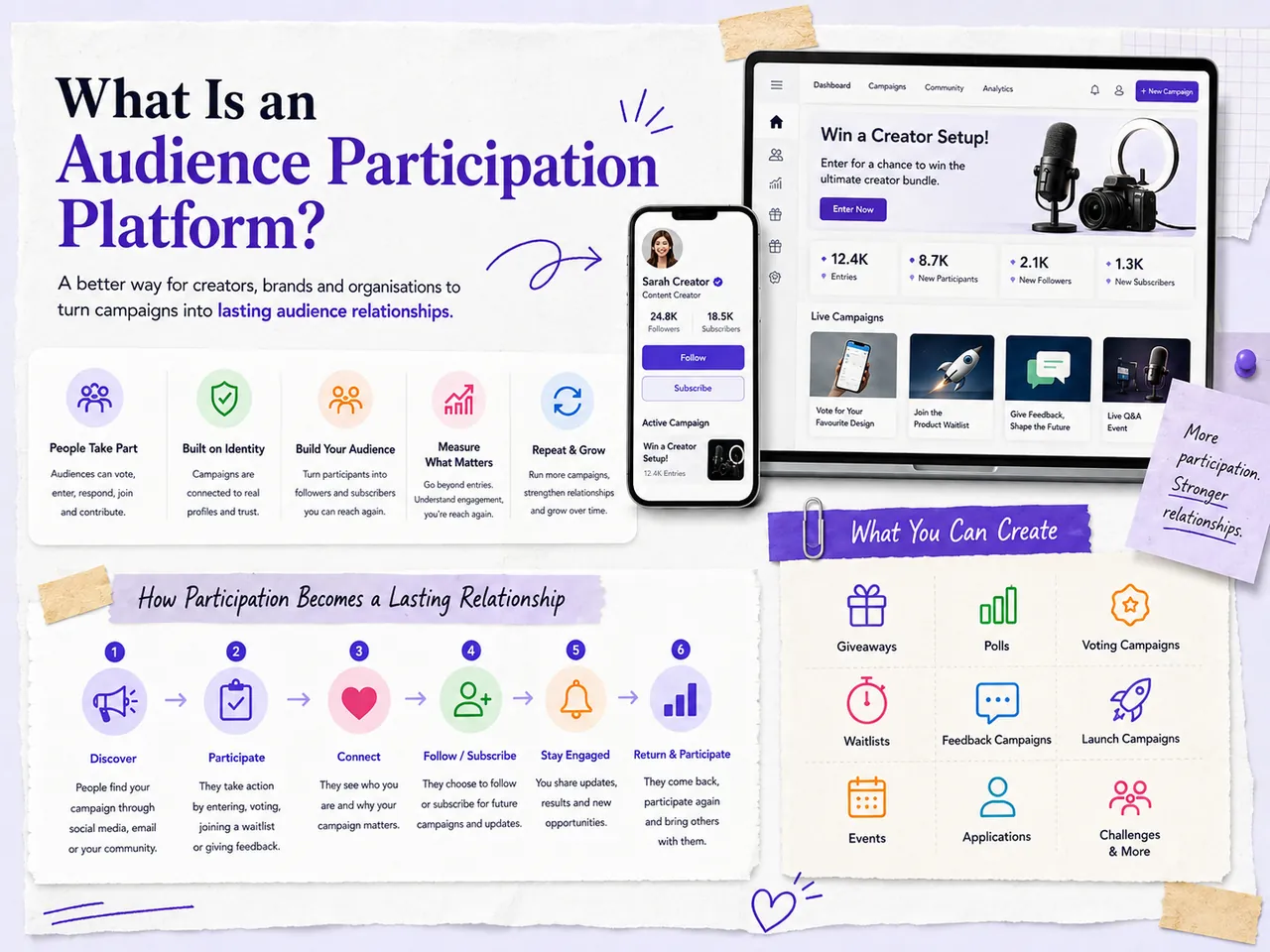
Instead of treating the audience as passive viewers, it gives people ways to vote, enter, respond, join, contribute, register interest and return for future campaigns.
That participation can happen through:
- Giveaways.
- Polls.
- Voting campaigns.
- Waitlists.
- Feedback campaigns.
- Launch campaigns.
- Events.
- Applications.
- Challenges and community activities.
The important difference is not simply the type of campaign.
It is whether participation creates an ongoing relationship or ends as soon as the campaign is over.
How an audience participation platform works
An audience participation platform gives creators, brands and organisations a central place to invite people to take action.
For example, someone may:
- Enter a giveaway.
- Vote for a finalist.
- Join a product waitlist.
- Respond to a poll.
- Submit feedback.
- Register for an event.
- Apply for an opportunity.
- Follow the campaign creator.
- Subscribe for future updates.
These actions are more intentional than simply viewing a post.
A view shows that content appeared on someone’s screen.
Participation shows that someone cared enough to do something.
That does not mean every action has equal value. A low-effort entry for a generic prize may reveal very little. A relevant subscription, detailed response or repeat campaign visit may reveal much more.
A useful participation platform should help campaign owners understand the difference.
How it differs from social media
Social media is extremely effective for distributing content.
It helps creators and brands reach people through videos, images, livestreams, posts and advertising.
But social platforms are mainly designed around publishing and discovery.
The usual process looks like this:
- A creator publishes something.
- The platform decides who sees it.
- People react or scroll past.
- The algorithm moves them to the next piece of content.
This creates reach, but it does not always create a strong audience relationship.
Followers may not see future posts. Engagement can rise or fall unexpectedly. Platform rules and algorithms can change. A creator may have thousands of followers but no reliable way to reach most of them.
An audience participation platform is not meant to replace social media.
It works alongside it.
A creator might promote a campaign through YouTube, Instagram, TikTok, Twitch, X, Facebook or email. The audience then moves from passive viewing to active participation.
Social platforms create attention.
A participation platform gives that attention somewhere useful to go.
How it differs from standalone campaign tools
Many existing tools solve one narrow problem.
A giveaway tool collects entries.
A survey tool collects answers.
A form builder collects information.
A ticketing tool manages registrations.
These tools can work well, but they often treat each campaign as a separate transaction.
Someone arrives, completes the action and leaves.
The campaign may not be strongly connected to the identity of the creator. Participants may not discover other campaigns. They may have no easy way to follow the organiser or return later.
Once the campaign ends, the relationship often ends too.
This creates a repetitive cycle:
- Launch a campaign.
- Promote it.
- Collect entries or responses.
- End the campaign.
- Start again from zero.
An audience participation platform should break that cycle.
It should connect individual campaigns to a wider identity, audience and history of activity.
What can people create?
An audience participation platform can support different campaign types depending on the organiser’s goal.
Giveaways
Giveaways can attract attention, reward an audience and introduce people to a creator or brand.
The strongest giveaways use relevant prizes and clear entry requirements rather than chasing the largest possible number of entries.
Polls
Polls help audiences take part in quick decisions.
They can be used to choose:
- A product colour.
- A future video topic.
- A design.
- An event date.
- A feature.
- A campaign idea.
Polls are simple, low-friction participation.
Voting campaigns
Voting campaigns allow communities to choose between people, ideas, products or submissions.
They can support:
- Talent contests.
- Community awards.
- Design competitions.
- Fan voting.
- Product choices.
- Shortlisting.
Waitlists
Waitlists help measure interest before something launches.
They can be used for:
- Products.
- Apps.
- Events.
- Courses.
- Memberships.
- Services.
- Limited releases.
A useful waitlist should do more than collect email addresses. It should help keep people interested until the launch happens.
Feedback campaigns
Feedback campaigns invite people to contribute ideas and opinions.
They may be used for:
- Product feedback.
- Feature requests.
- Customer research.
- Event feedback.
- Content ideas.
- Community suggestions.
The strongest feedback campaigns show participants how their responses may influence what happens next.
Launch campaigns
Launch campaigns bring several participation tools together around a product, project, film, app, event or announcement.
A launch may include:
- A waitlist.
- A giveaway.
- A poll.
- Product information.
- Updates.
- Collaborators.
- Subscriber collection.
- A livestream or event.
Instead of spreading the launch across disconnected pages, the campaign creates one central place for participation.
Why identity matters
People are more willing to participate when they know who is behind the campaign.
A trustworthy campaign should make it clear:
- Who created it.
- What the organiser does.
- Whether their website or identity has been verified.
- Which collaborators or sponsors are involved.
- What other campaigns they have created.
- How participant information will be used.
- How suspicious activity can be reported.
This matters because campaign pages often ask people to submit information, join a waitlist, enter a competition or follow future activity.
An anonymous page with vague details and no visible identity creates doubt.
A participation platform should connect campaigns to real creator or organisation profiles rather than treating them as isolated forms.
Why repeat participation matters
A single campaign can create temporary attention.
Repeated participation can create an audience.
Someone may first discover a creator through a giveaway, then vote in a poll, join a waitlist and return for a launch event.
Each interaction strengthens the relationship.
A better model looks like this:
- Someone discovers a campaign.
- They take part.
- They learn who created it.
- They follow or subscribe.
- They return for another campaign.
- The creator builds an audience over time.
This is more valuable than collecting a large number of one-time entries from people who never return.
A strong participation platform should help campaign owners understand:
- How many people are new.
- How many have participated before.
- Which campaigns create followers or subscribers.
- Which traffic sources bring relevant participants.
- Whether people return after the campaign ends.
Raw entry numbers alone can be misleading.
A campaign with fewer but more relevant participants may be more valuable than one with thousands of low-intent entries.
Where GiveLab fits
GiveLab is being built as an audience participation platform.
It is designed to help creators, brands and organisations run campaigns while building an audience around those campaigns.
Rather than treating every giveaway, poll, waitlist or voting campaign as an isolated page, GiveLab connects participation to:
- Public profiles.
- Followers.
- Subscribers.
- Creator identity.
- Collaborators.
- Sponsors.
- Campaign discovery.
- Repeat participation.
- Analytics.
- Future campaigns.
The goal is not simply to collect more entries, votes or responses.
It is to help campaign owners attract the right people, understand how they participate and give them a reason to return.
How Campaign Intelligence can help
GiveLab Campaign Intelligence is designed to assist campaign owners while they plan and improve campaigns.
It may help with decisions such as:
- Choosing the right campaign type.
- Clarifying the campaign goal.
- Selecting an appropriate prize.
- Improving entry actions.
- Identifying potential campaign risks.
- Suggesting ways to increase relevant participation.
- Understanding campaign performance.
Campaign Intelligence should support human judgement, not replace it.
The campaign owner still needs to understand their audience, verify important details and make sure the campaign is appropriate and practical.
GiveLab is not only a giveaway platform
Giveaways are one form of participation, but they are not the whole product.
A creator might use GiveLab to:
- Run a giveaway to attract attention.
- Ask followers to vote on the next content idea.
- Create a waitlist for a product.
- Host a launch campaign.
- Collect feedback.
- Invite the same audience into the next campaign.
That is the broader model.
The campaign types may change, but the audience relationship continues.
Frequently asked questions
What is an audience participation platform?
An audience participation platform helps creators, brands and organisations invite people to actively take part through giveaways, polls, waitlists, voting, feedback, launches and other campaigns.
Is audience participation the same as engagement?
Not exactly.
Engagement includes signals such as views, likes, comments and shares.
Participation usually involves a more deliberate action, such as voting, entering, responding, applying or joining.
Is GiveLab only for giveaways?
No.
GiveLab is designed to support several campaign types, including giveaways, polls, voting campaigns, waitlists, feedback and launches.
Does GiveLab replace social media?
No.
Social media remains important for reach and content distribution.
GiveLab is designed to work alongside social platforms by giving audiences a place to participate and remain connected.
Why are followers and subscribers important?
Participants may visit for one campaign and never return.
Following or subscribing gives them a way to stay connected and discover future activity.
Who can use GiveLab?
GiveLab can be used by creators, brands, businesses, streamers, artists, event organisers, communities and organisations that want people to participate.
Turn attention into participation
Online audiences are surrounded by content.
The challenge is no longer simply getting something in front of them.
The challenge is giving people a meaningful reason to take part.
An audience participation platform connects campaigns, creators and audiences through repeated moments of participation.
GiveLab is being built around that model.
The campaign is not the end of the relationship, at GiveLab
It is the beginning.